

Cloud computing in India: Current status and future forecasts by various Research Firms
With cloud computing market getting mature globally, including in the developing countries, the last 10 months in India this year, witnessed a lot of activities in this segment. While many brands and entrepreneurs have forayed into this category, some existing ones also attracted significant investments from the angels and VCs.
To name a few, there is a startup called Freshdesk, which provides a cloud based personal accounting solution. Bookyourtable, the online table reservation service came in news for using cloud services to provide real time booking options for restaurants. And then, there were brands like Oracle and Dell which acquired Bigmachines and Enstratius respectively, to gain technological advantage in the sector. And not to forget, even the Indian Government has recently taken an initiative to launch a national cloud, known as Meghraj.

Talking about the fundings scenario, Bangalore based Numerify raised USD 8 Mn this quarter. Chennai based IT firm, Sify Technologies has also recently announced to invest in or partner with technology startups focusing on cloud, security and managed services. This involves a major amount of INR 30 Crores for initial investments, and INR 120 crores for future investments in this field.
Some other names to be look forward for new innovations in cloud this year include BSNL, Tata Communications, British Telecom, OpenXcell, HP etc.
- The scenario thus clearly demands a clear picture of the market opportunities available and the expected future of cloud in the country. To understand this, we have clubbed below a summary of a few reports from popular research analyst firms published in the last one year, with most published during the last quarter of 2013 only.

1) Gartner: Cloud computing will become the bulk of new IT spend by 2016. From 2012 through 2017, across all segments of the cloud computing market, cloud services revenue is projected to have a CAGR of 33.2%, with SaaS and IaaS growth rates projected to be 34.4% and 39.8% respectively.
2) Cisco Consulting Services (CCS): The study surveyed 4,226 IT leaders in 18 industries across 9 key economies, including 600 from India. Wherein about 83% of respondents in India were “very satisfied” and another 13% “somewhat satisfied” with cloud, representing a total 96% positive rating.
3) VMware, Inc. Cloud index: A study, conducted by Forrester Research across 12 Asia Pacific countries, reveals that nearly 89% respondents in India believe that Cloud Computing, or ‘as-a-service’ approach, is relevant to their organisation and nearly 79% say they currently have a cloud-related initiative in place within the organisation, or are planning to implement cloud, or ‘as-a-service’ approach, in the next 12 months.
4) CII: Public cloud computing in India is forecast to grow 36% in 2013 to total USD 443 Mn, up from USD 326 Mn in 2012. The Indian IT-BPO vendors can develop their social media, mobility, analytics and cloud computing (SMAC) strategies and cross the USD 225 Bn mark by 2020.
5) Microsoft IDC study: Cloud computing will generate some 14 Mn new jobs worldwide by 2015, and India alone will create over 2 Mn jobs.
6) EMC and Zinnov Management Consulting: India would require at least 100,000 professionals in private cloud alone by 2015

Well, everything seems quite good, right? But there’s a negative aspect too. As per, BSA Global Cloud Computing Scorecard 2013, India still lags behind developed countries (with 17th rank of the 24 countries surveyed) in policies, like data privacy, security, intellectual property rights, cybercrime etc., which are considered critical for the future of cloud computing. Also, international giants in cloud like Amazon, despite of having a wider customer base in India, are not interested in putting up data centres in the country due to riskier infrastructure and stringent data security laws.
However, industry experts have a view that India can still become a hub for global cloud computing. “Indian firms have reached a maturity in the total outsourcing space, taking away entire IT needs of large organisations end- to-end. In the cloud scenario they will take this story forward, forming new partnerships and new business models,” said Srikanth Karnakota, director of Microsoft’s server and cloud business.

Thus, it’s pretty clear that India has a high potential to offer much better opportunities in Cloud. Also, the way both the private and government players are taking initiatives, and the pace at which the IT professionals and entrepreneurs are making use of this technology, the scope in the future is going to be immense.
Cloud Infrastructure:-

- Cloud infrastructure consists of servers, storage devices, network, cloud management software, deployment software, and platform virtualization.
Hypervisor
Hypervisor is a firmware or low-level program that acts as a Virtual Machine Manager. It allows to share the single physical instance of cloud resources between several tenants.
Management Software
- It helps to maintain and configure the infrastructure.
- It helps to maintain and configure the infrastructure.
Deployment Software
- It helps to deploy and integrate the application on the cloud.

Network
It is the key component of cloud infrastructure. It allows to connect cloud services over the Internet. It is also possible to deliver network as a utility over the Internet, which means, the customer can customize the network route and protocol.
Server
The server helps to compute the resource sharing and offers other services such as resource allocation and de-allocation, monitoring the resources, providing security etc.
Storage
Cloud keeps multiple replicas of storage. If one of the storage resources fails, then it can be extracted from another one, which makes cloud computing more reliable.
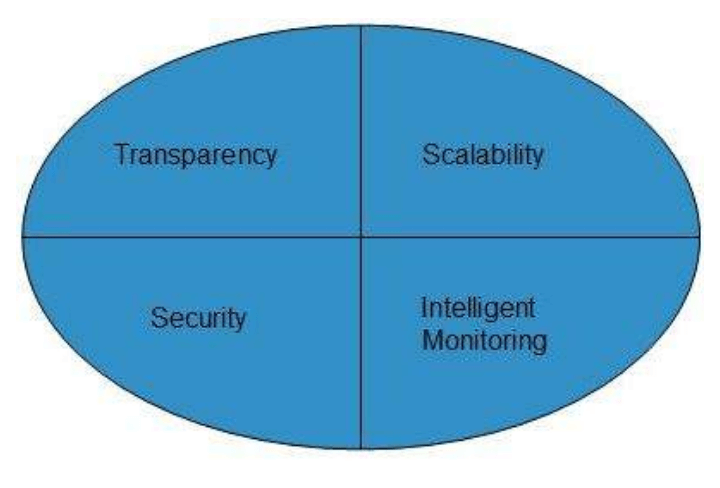
Fundamental constraints that cloud infrastructure should implement are shown in the following diagram:
Transparency
Virtualization is the key to share resources in cloud environment. But it is not possible to satisfy the demand with single resource or server. Therefore, there must be transparency in resources, load balancing and application, so that we can scale them on demand.
Scalability
Scaling up an application delivery solution is not that easy as scaling up an application because it involves configuration overhead or even re-architecting the network. So, application delivery solution is need to be scalable which will require the virtual infrastructure such that resource can be provisioned and de- provisioned easily.
Intelligent Monitoring
To achieve transparency and scalability, application solution delivery will need to be capable of intelligent monitoring.
Security
The mega data center in the cloud should be securely architected. Also the control node, an entry point in mega data center, also needs to be secure.
Many encouraging trends in cloud computing are transforming the IT landscape in India, the ripples of which are felt even beyond the national boundaries. Of late, India’s proactive roles in cloud services have generated much excitement among technology leaders in countries such as the U.S. This progressive march of cloud computing in India has business significance, and observers paint an optimistic picture for the future. Here’s a look at how India is fast becoming a hub for both rapid cloud consumption as well as one of the best cloud hosting service providers.
Cloud Computing Architecture:-

Cloud Computing architecture comprises of many cloud components, which are loosely coupled. We can broadly divide the cloud architecture into two parts:
1).Front End
2).Back End
Each of the ends is connected through a network, usually Internet. The following diagram shows the graphical view of cloud computing architecture:
Front End:-
The front end refers to the client part of cloud computing system. It consists of interfaces and applications that are required to access the cloud computing platforms, Example - Web Browser.
Back End:-
The back End refers to the cloud itself. It consists of all the resources required to provide cloud computing services. It comprises of huge data storage, virtual machines, security mechanism, services, deployment models, servers, etc.
Note:-
It is the responsibility of the back end to provide built-in security mechanism, traffic control and protocols. The server employs certain protocols known as middleware, which help the connected devices to communicate with each other.
Example of cloud:-
- Cloud Computing Types
- Cloud Computing Service Architecture
- Cloud Computing Reference Model
- Cloud Computing Types
- Cloud Computing Service Architecture
- Cloud Computing Reference Model
Sorry For This Long Aritical Because This Part Is Deficult But I
Tride To Easy To Understand For You Guys.I Hope You Like This Aritical.





2 Comments
Thanks... :)
ReplyDeleteCloud Computing is a model for enabling convenient, on-demand network-based access to a shared pool of configurable computing resources (e.g., networks, servers, storage, applications, and services) that can be rapidly provisioned and released with minimal management effort or service provider interactions.https://www.techpally.com/virtualization-types-in-cloud-computing/
ReplyDelete